White Angelica Script Handwritten Font for Elegant Branding
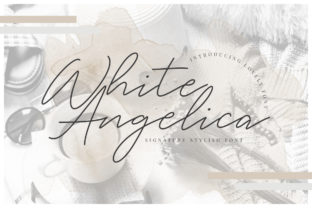
It was 10 p.m., candle wax still smudged on my desk, and I was tweaking the final label design for a new lavender-vanilla soy candle—my first batch in months. I’d tried three fonts already: one too stiff, one too trendy, one that looked like it belonged on a juice box. Then I opened White Angelica, typed “Bloom & Ember,” and just… paused. That’s how White Angelica hits you—not with loud contrast or sharp edges, but with quiet confidence. As a Script Handwritten font, it doesn’t mimic calligraphy—it breathes like it was written in one steady, unhurried motion. The flow is organic, the terminals taper naturally, and the slight variation in stroke weight gives it warmth without sacrificing clarity. This isn’t just another decorative Fonts download—it’s a design partner that elevates handmade goods before a single label is printed.
White Angelica for Wedding Invitations and Elegant Branding
I tested White Angelica across three real wedding stationery pieces: a digital save-the-date preview, a printed invitation suite (letterpress + foil accent), and a hand-painted welcome sign mockup. On screen, the script shines in social media posts and email headers—its natural rhythm reads as personal and intentional, never generic. In print, it held up beautifully at 24–36 pt sizes: the swashes stayed crisp, the spacing felt generous, and the lowercase “g” and “y” added subtle character without distracting. For branding, I used White Angelica as the primary logo treatment for a fictional boutique florist—and paired it with a light, airy sans serif (like Montserrat Light) for body text. The contrast worked instantly: elegance + approachability. As a Script Handwritten font, White Angelica excels where emotional resonance matters most—invitations, monogrammed napkins, vow books, and even delicate envelope addressing. Just avoid using it for fine-print details like RSVP deadlines or venue maps; stick to display roles.
White Angelica on Candle Labels, Product Tags, and Packaging Design
Candle labels are where White Angelica truly surprised me. At 14–18 pt on a 2” x 3” kraft sticker, the script remained legible—even when scaled down for small-batch testing. I ran it through my Cricut Maker (using Print & Cut mode) and had zero tracking issues—the letterforms are clean enough for precise cutting, yet expressive enough to feel handmade. Paired with a thin serif (like Playfair Display Italic) for scent descriptions, White Angelica became the hero element—soft but confident, organic but intentional. For boutique packaging, I used it on belly bands, gift tags, and tissue paper stamps. Its natural flow mimics ink-on-paper texture, so even digitally printed materials gain tactile appeal. As a Fonts choice for physical goods, White Angelica supports brand cohesion across touchpoints—especially when you’re selling across Etsy, Instagram, and local markets. Pro tip: test your file formats (OTF works best for cutting machines; TTF for web previews) and always check licensing if you’re embedding into printable templates or SVG bundles.
White Angelica for Social Media Posts, Digital Downloads, and Planner Pages
If you create digital printables—or sell Canva templates, Notion planners, or printable wall art—White Angelica adds instant polish. I dropped it into a set of minimalist quote cards (for Instagram Stories), a monthly habit tracker layout, and a set of botanical-themed affirmation pages. Because it’s a Script Handwritten font with generous letter spacing and open counters, it stays readable even at 16–20 pt on mobile screens. No pixelation, no awkward kerning gaps—just smooth, graceful lines that invite pause and reflection. For social media graphics, I used White Angelica for headlines only (never body copy), then layered it over soft watercolor textures or linen backgrounds. It performs especially well in Pinterest-optimized verticals: think “self-care checklist,” “wedding planner cover,” or “small business vision board.” Just remember: White Angelica is a display Fonts asset—not meant for paragraphs, captions, or dense instructions. Keep it reserved for names, titles, quotes, and decorative emphasis.
White Angelica on Mugs, Tote Bags, and Merchandise Mockups
When I mocked up a ceramic mug design with “Slow Morning” in White Angelica, the result felt like something you’d find at a curated boutique—not mass-produced. Same with a canvas tote bag reading “Made With Care.” The script’s gentle slant and rhythmic spacing translate beautifully to curved surfaces and fabric prints. For DTG (direct-to-garment) or sublimation, I recommend using White Angelica at minimum 28 pt and avoiding tight curves or overlapping letters—its elegance comes from breathing room. I also tested it on vinyl decals for farmhouse-style wood signs, and it cut cleanly every time (no jagged edges or lost terminals). As a Script Handwritten font, White Angelica lends authenticity to handmade merchandise because it doesn’t try to be perfect—it feels human, grounded, and quietly refined. And yes—it’s licensed for commercial use, so whether you’re selling mugs on Etsy or bundling fonts into a designer toolkit, you’re covered.
What to Know Before You Use White Angelica Fonts
- Best for: Names, titles, logos, short phrases, invitations, labels, social headers, and decorative accents—not long paragraphs or technical specs.
- Pairing suggestion: A clean sans serif (like Inter or Lato) for balance; avoid other scripts unless they’re extremely minimal and low-contrast.
- Readability note: Works reliably down to ~12 pt on high-res print, but avoid sub-10 pt or tiny sticker cuts—delicate swashes may blur or break.
- Licensing: Confirm commercial rights are included—most reputable sellers offer full commercial use for physical + digital products, including templates and SVGs.
- File types: Look for OTF (best for vector work and cutting machines) and TTF (ideal for web and app previews); bonus points if ligatures or alternate characters are included.